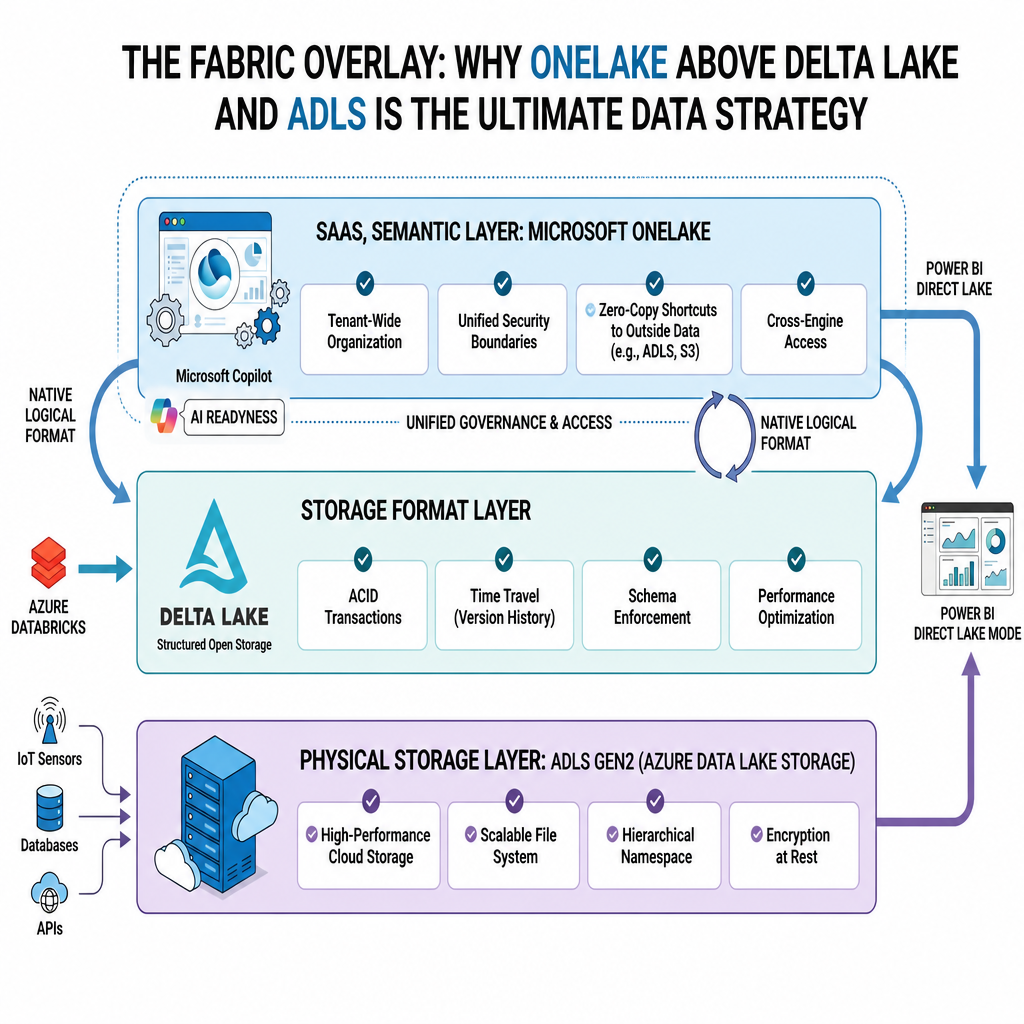
For years, building an enterprise data lake followed a familiar blueprint: spin up Azure Data Lake Storage (ADLS Gen2), format your data into Delta Lake (or Parquet) for ACID transactions, and orchestrate it all using tools like Azure Databricks or Synapse. It works, but it often leaves organizations managing fragmented storage accounts, complex security access control lists (ACLs), and duplicate data copies across different environments.
Enter Microsoft OneLake. Positioned directly on top of ADLS and Delta Lake, OneLake functions as a single, unified logical layer for your entire organization. It doesn’t replace your storage; it abstracts it, transforming isolated data lakes into an interconnected corporate “OneDrive for Data.”
The Core Concept: Logical Layering
To understand OneLake, you have to look at how it wraps around your existing infrastructure. Instead of creating brand new data silos, OneLake acts as an overlay that unifies physical data stored across different workspaces and regions.
By acting as a unified front-end, OneLake standardizes how data is organized, accessed, and governed across the business without requiring complex data movement pipelines.
Architectural Breakdown: How OneLake Enhances Your Stack
When you sit OneLake on top of ADLS Gen2 and the Delta Lake format, the architecture shifts from a physical management nightmare to a logical breeze.
1. One Security and Governance Model
Traditionally, setting up security across multiple ADLS accounts required meticulous management of Azure RBAC and POSIX ACLs. OneLake simplifies this by introducing a single governance boundary. Security policies defined at the Fabric domain or workspace level automatically cascade down to the underlying data, ensuring consistent access whether a user is querying via Power BI, SQL, or Python.
2. The Power of “Shortcuts” (Zero-Copy Architecture)
One of OneLake’s most powerful architectural features is Shortcuts. If you have massive datasets already living in independent ADLS Gen2 accounts (or even AWS S3), you don’t need to migrate them.
- A Shortcut creates a symbolic link from OneLake to your existing ADLS storage.
- To the end-user or AI tool, the data appears locally inside OneLake.
- In reality, the data remains exactly where it is, eliminating data duplication and egress costs.
3. Delta Lake as the Native Language
OneLake adopts Delta Lake (and Parquet) as its native, canonical data format. Every Fabric engine—whether it’s Synapse Data Engineering, Data Warehouse, or Power BI—reads and writes Delta tables. Because Delta Lake is open-source and ACID-compliant, your existing Databricks or custom Spark pipelines can interact with OneLake seamlessly, ensuring zero vendor lock-in.
Comparing the Layers
To see how these technologies complement rather than compete with each other, it helps to break down their distinct responsibilities:
| Layer | Component | Core Responsibility |
| SaaS & Semantic Layer | Microsoft OneLake | Tenant-wide organization, unified security, shortcuts, and cross-engine access. |
| Storage Format Layer | Delta Lake | ACID transactions, time travel, schema enforcement, and performance optimization. |
| Physical Storage Layer | ADLS Gen2 | High-performance, scalable cloud file storage, hierarchical namespaces, and encryption at rest. |
Why This Architecture Changes the Game
By placing OneLake over your existing Delta/ADLS foundations, you unlock three massive advantages:
- Direct Lake Mode in Power BI: Power BI can read Delta tables directly from OneLake without importing or duplicating the data into memory. This gives you import-mode speed on top of massive, real-time data lake volumes.
- No More Silos: Every team gets their own workspace, but they all operate out of the same tenant-wide lake. Data discovery becomes instant.
- AI Readiness: Because your enterprise data is unified into a single logical lake with a clean semantic meaning, grounding enterprise AI agents (like Microsoft Copilot) becomes significantly easier and more secure.
The Bottom Line: OneLake doesn’t replace the robust data engineering foundation you’ve built on ADLS and Delta Lake; it finalizes it, delivering a polished, collaborative SaaS experience on top of your enterprise raw materials.