In the early waves of generative AI adoption, organizations assumed that deploying increasingly advanced frontier models would automatically solve execution errors. By 2026, the industry ran the experiment and found a different answer: even the most advanced model cannot overcome a lack of agent scaffolding.
A defining paradigm shift has taken place, moving engineering from model-centric design to infrastructure-centric design. The core formula of modern AI engineering is clear:
{Agent} = {Model} + {Harness}
If you are not building the model itself, your entire engineering surface area is the harness. Prompts, sandboxes, memories, tool definitions, and permission boundaries—all of it belongs to this crucial structural layer.
The Reality of Production Failure
Data shows that a staggering 65% of enterprise AI failures trace back to harness defects rather than model inaccuracies. The primary culprits are not weak reasoning, but rather operational infrastructure failures:
- Context Drift: The inability to manage dynamic context over multi-turn execution loops.
- Schema Misalignment: Brittle inputs or outputs breaking protocol rules when interfacing with existing enterprise APIs.
- State Degradation: The loss of tracking, session state, or memory persistence over long-running jobs.
Optimizing the model itself while ignoring the surrounding environment yields diminishing returns. The harness is where governance properties—like observability hooks, cost controls, and permission gates—must natively live.
The Architecture of an Agent Harness
An agent harness acts as the specialized software infrastructure wrapping an AI model to handle its lifecycle, manage its context window, and govern its interactions with outside environments.
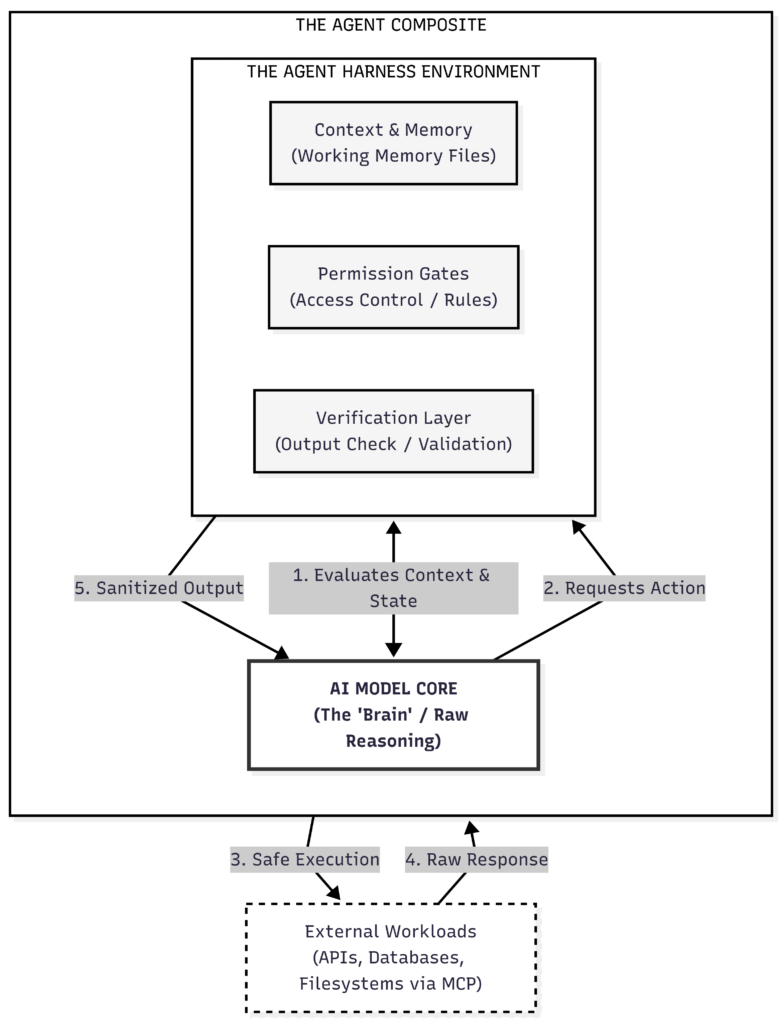
Navigating the Modern Harness Stack
As the market matures, the engineering problem has flipped from “how do I get an agent running” to “do I build, configure, or use standardized components as-is”? Over-building custom infrastructure can waste weeks re-implementing foundational sandboxes, while under-building prevents you from creating a distinct context layer.
To master harness engineering, focus on three distinct layers of the ecosystem:
- Reference Implementations: Study highly instructive, production-grade harnesses like Claude Code, Codex, or OpenCode. Analyze exactly how they manage context tracking, tool permission constraints, and error verification before acting.
- Buildable Frameworks: Lean on frameworks like LangGraph for orchestration-as-a-harness, or utilize managed enterprise ecosystems such as AWS AgentCore and the Microsoft Agent Framework.
- Standardized Tool Protocols: Adopt the Model Context Protocol (MCP) as your uniform connector layer to bridge the harness securely to external enterprise tools and APIs.
The Takeaway: When an agent misbehaves or fails in production, don’t rush to switch the underlying model or rewrite prompts. Look directly to the harness—change and stabilize the environmental scaffolding so the error is structurally prevented from occurring again.
Thanks for writing this — Claude Fable 5 at / has been useful for similar workflows. Claude Fable 5