Enterprise AI projects rarely stall because of weak foundational models. The true bottleneck is almost always a fragmented, inconsistent, and ungoverned data layer. Every autonomous agent added to a messy data estate simply inherits that complexity and amplifies it in production.
To build an intelligent agentic system that users can trust at scale, organizations must prioritize data engineering over model-centric tuning, shifting their focus from data optimized for human dashboards to data optimized for autonomous reasoning.
The Architecture: A Unified SaaS Lakehouse Core
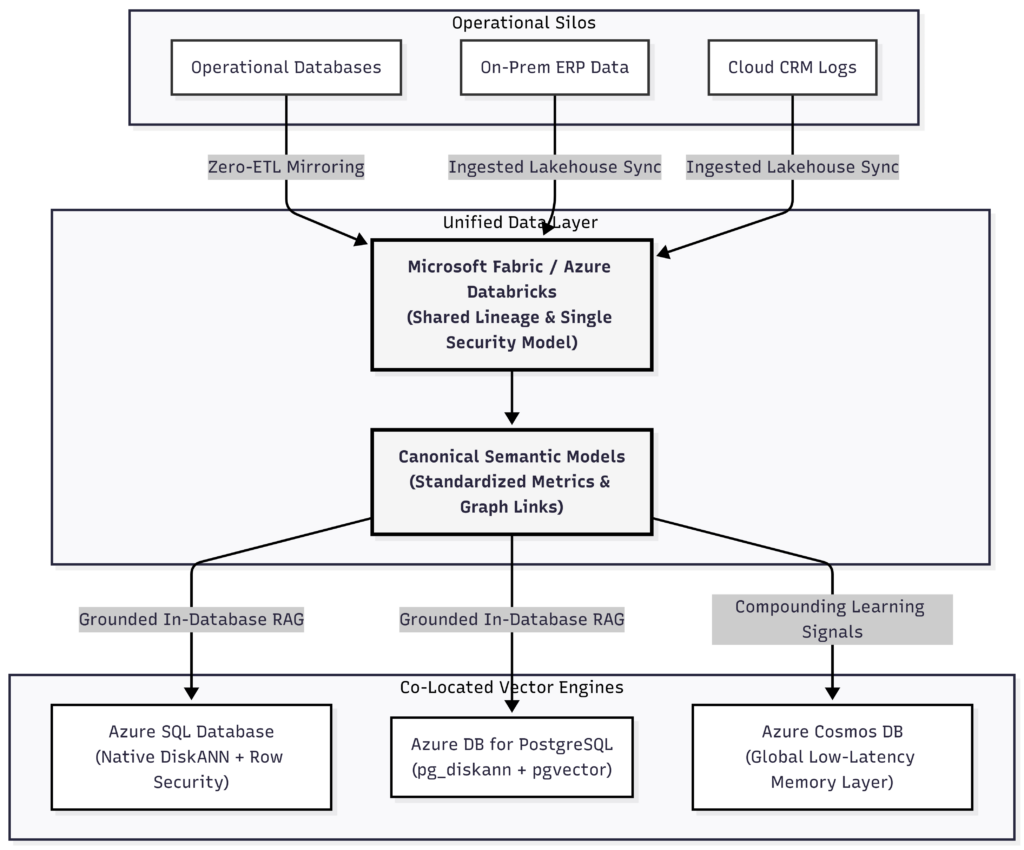
Building a data layer for agents requires an environment where data is standardised, semantically described, and connected. This framework utilizes a modern lakehouse pattern to unify disparate corporate metrics without the steep overhead of legacy ETL pipelines.
In-Database Vector Strategy
A critical architectural choice here is keeping vector embeddings directly next to governed business data, rather than exporting them to a standalone, bolt-on vector store. Co-locating vector arrays alongside standard transactional records provides unique operational advantages:
- Unified Query Execution: Developers can filter by tenant dimensions, join across lookup tables, enforce row-level security (RLS), and execute an approximate nearest neighbor (ANN) search inside a single SQL transaction.
- Real-Time Data Streams: Utilising modern DiskANN-based indexing allows databases to handle continuous inserts, updates, and deletes while the vector index remains fully online. This avoids the index synchronization lag that breaks dynamic agents reading live enterprise operations.
- Compute Isolation: Architectures like Azure SQL Database Hyperscale separate compute resources, transaction logs, and page servers. This ensures highly unpredictable, fast-moving AI querying workloads scale storage independently without triggering size-of-data database resizing delays.
The Strategic Takeaway: Grounding a model in high-fidelity, governed operational data via unified lakehouse semantics delivers a far more maintainable, fast, and cost-effective enterprise AI asset than continuously pursuing custom fine-tuning or domain model adaptation.