Reference: Adapted and expanded fromThe 12 Data Architecture Patterns Every Data Engineer Should Master.
The Data Lake vs Warehouse debate is effectively over. Modern enterprise engineering is no longer about picking a single isolated design; it is about knowing how to compose interoperable, composable data patterns into a reliable, governed ecosystem.
1. Storage & Ingestion Foundations

1. Medallion Architecture (The Refinement Ladder)
- Purpose: Progressively clean, normalize, and enrich data across quality tiers.
- Tiers:
- Bronze: Raw ingestion, append-only, immutable historical landing.
- Silver: Cleaned, deduplicated, conformed, and joined records.
- Gold: Highly aggregated, business-ready models powering BI and ML features.
- Why It Works: Decouples raw ingestion from transformation, meaning you never re-pull from source systems—you simply rebuild downstream.
2. Data Lake Architecture (Store First, Schema Later)
- Purpose: Cost-effective, scalable object storage for structured, semi-structured, and unstructured data.
- Mechanism:Schema-on-Read. Raw data lands with zero upfront modeling; schemas are applied dynamically at query time.
- Trade-off: Maximum flexibility, but without active cataloging it becomes an unmaintainable “data swamp.”
3. Data Warehouse Architecture (The BI Workhorse)
- Purpose: Highly structured, curated storage optimized for fast SQL analytics and reporting.
- Mechanism:Schema-on-Write. Rigorous ETL cleans and models data before persistence, delivering deterministic reporting at the cost of ingest agility.
4. Lakehouse Architecture (The Modern Standard)
- Purpose: Blends the cheap, open file storage of a Data Lake (Parquet) with the ACID transactional integrity and schema enforcement of a Data Warehouse.
- Core Formats: Apache Iceberg, Delta Lake, and Apache Hudi.
2. Real-Time & Streaming Paradigms
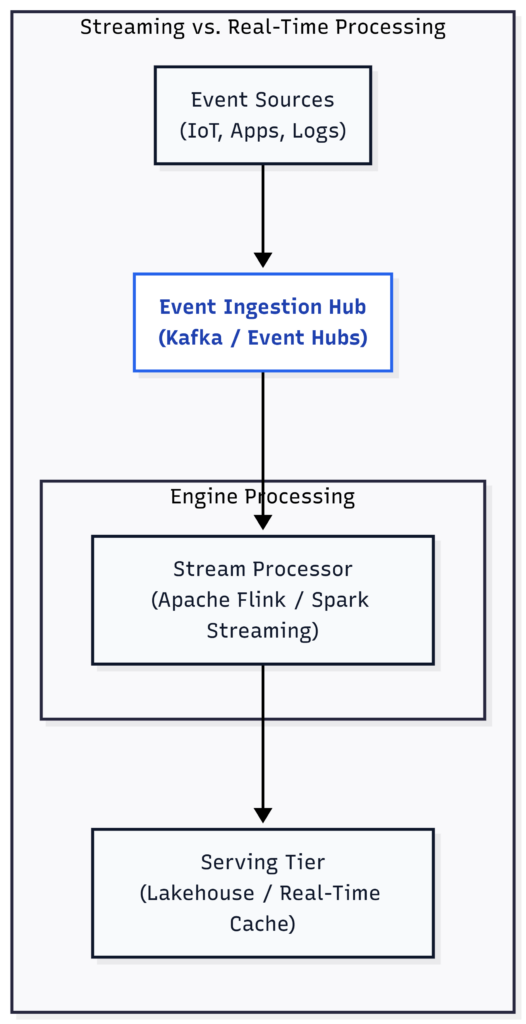
5. Lambda Architecture (Batch Meets Speed)
- Purpose: Delivers real-time views alongside comprehensive historical accuracy by maintaining parallel pipelines.
- The “Lambda Tax”: Maintaining double the codebase—one set of logic for batch processing and another for stream processing.
6. Kappa Architecture (Everything is a Stream)
- Purpose: Eliminates the dual-codebase overhead of Lambda by treating all historical and real-time data as a single continuous log.
- Mechanism: Re-processing history is accomplished simply by replaying the streaming log from an earlier offset.
7. Event-Driven Architecture (Systems That React)
- Purpose: Decouples distributed microservices through asynchronous pub/sub messaging queues. Services publish events and react to updates independently.
8. Modern End-to-End Streaming
- Purpose: Real-time stream processing that immediately commits ACID-compliant events directly into Iceberg or Delta tables with near-zero latency.
3. Governance, Organization & Enterprise Scale
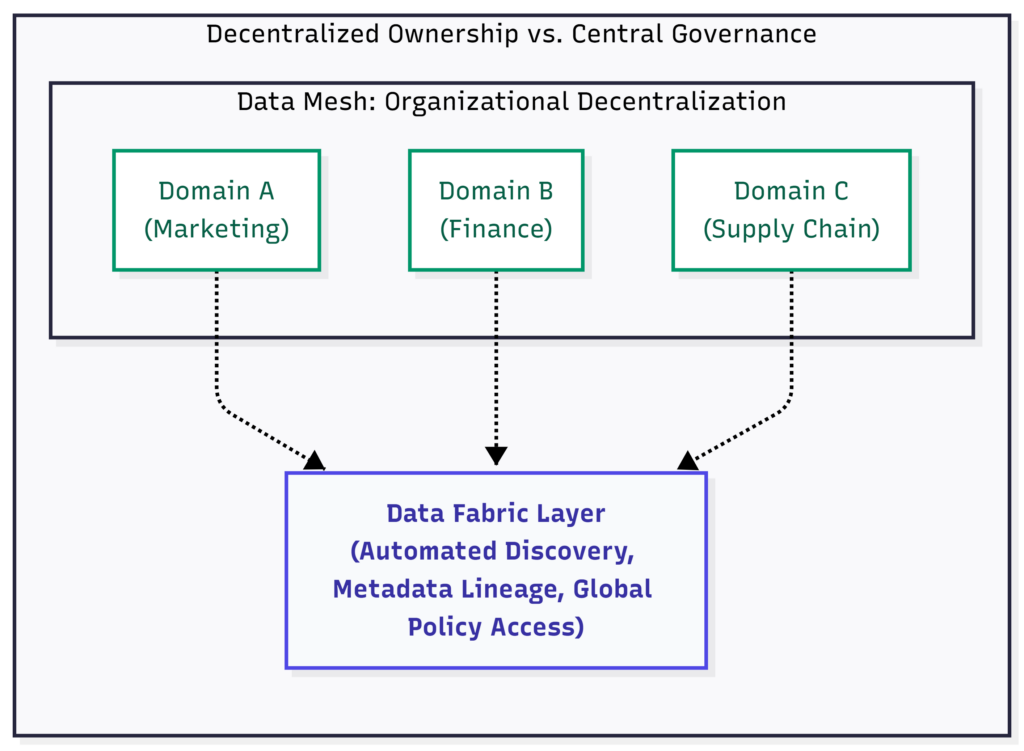
9. Data Mesh (Decentralized Domain Ownership)
- Core Philosophy: Treats data as an organizational product. Domain teams (Finance, Marketing) own their own data products and pipelines, supported by a shared self-service infrastructure platform.
10. Data Fabric (The Active Metadata Plane)
- Core Philosophy: A centralized, tech-driven software layer that automates discovery, maps global lineage, and enforces access policies across heterogeneous storage silos without moving the physical files.
11. Hub-and-Spoke Architecture
- Purpose: A centralized, conformed data warehouse (the Hub) feeds specialized, departmental data marts (the Spokes) tailored to individual team query patterns.
12. Data Vault Architecture (Auditable Historical Modeling)
- Components:
- Hubs: Unique business keys (The What).
- Links: Transactional relationships between keys (The How).
- Satellites: Time-stamped descriptive attributes (The History).
- Best For: Highly regulated industries (Banking, Insurance) requiring complete historical point-in-time reconstruction.
How They Fit Together: The Composite Production Stack
Production environments do not pick a single pattern in isolation. A modern retail or financial platform combines several patterns into a unified stack:
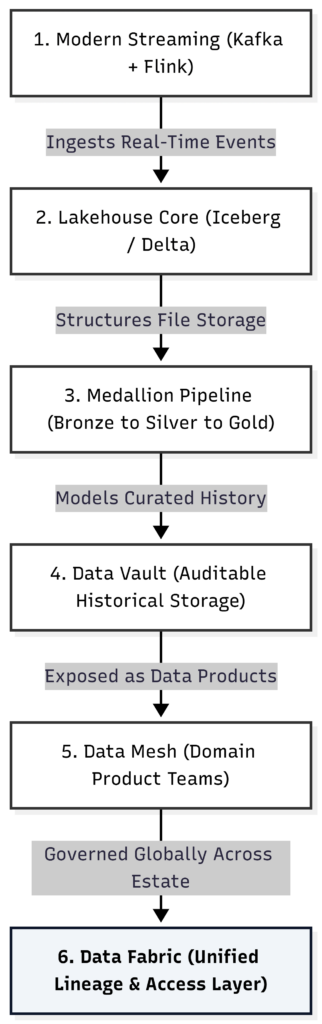
Quick Architecture Decision Matrix
| Your Business & Technical Requirement | Primary Architectural Patterns to Combine |
| Modern Analytics & Machine Learning Platforms | Lakehouse + Medallion Architecture + Modern Streaming |
| Real-Time Dashboards with Continuous Ingestion | Kappa Architecture + Event-Driven Pub/Sub |
| Strict Regulatory Audits & Point-in-Time History | Data Vault + Lakehouse Storage |
| Scaling Across Multiple Autonomous Business Units | Data Mesh (Org Model) + Data Fabric (Governance Layer) |
| Central Truth with Departmental Flexibility | Hub-and-Spoke + Data Warehouse |