Enterprise AI is moving past experimental “shadow IT” and ad-hoc API scripts. To scale safely, organizations require robust governance, security boundaries, and reliable delivery pipelines.
Microsoft Azure AI Foundry serves as the core platform to bring order to this landscape, establishing production-grade architectures that balance developer agility with corporate control. Below is a breakdown of how to structure an enterprise-grade AI deployment across five critical architectural layers.
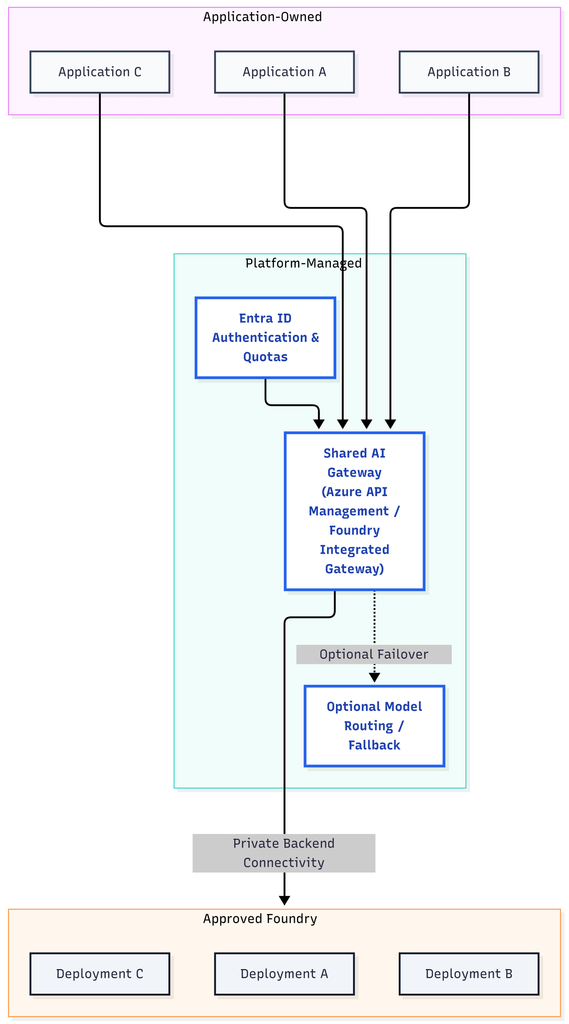
1. The Shared AI Gateway: Consolidating Access and Control
Deploying endpoints on Azure OpenAI or custom models is straightforward; the difficulty arises when multiple business units require access. Direct application-to-model integration creates security risks, makes tracking token spend difficult, and often leads to rate-limiting failures.
By routing all application requests through a platform-managed Shared AI Gateway (implemented via the Foundry Integrated AI Gateway or Azure API Management), you establish an essential operational control plane:
- Entra ID Authentication: Enforces consistent, managed identity verification across all consumer applications instead of scattering fragile API keys.
- Per-Consumer Quotas & Usage Attribution: Sets distinct token limits, prevents noisy-neighbor resource starvation, and attributes cloud costs directly to the responsible application.
- Intelligent Routing & Fallback: Maintains private backend connectivity to approved model deployments while supporting dynamic failover branches to alternative models or regions during peak load or rate limits.
- Centralized Telemetry: Automatically pipes usage, error rates, latency, and token spend into Application Insights and Log Analytics.
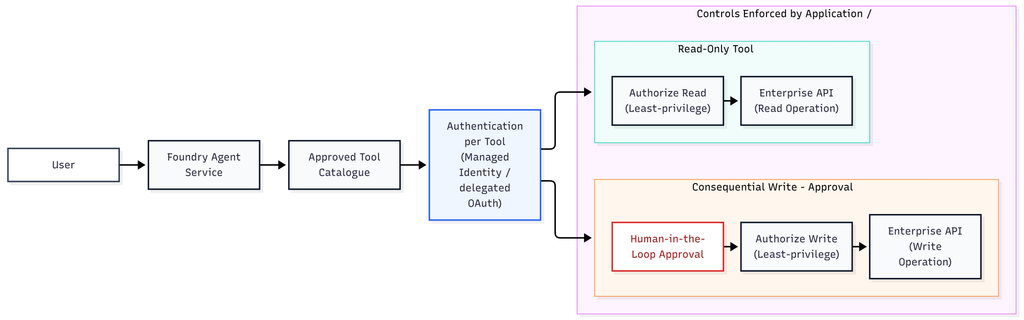
2. Secure Agent Actions: Separating Intents from Impacts
Autonomous agents need tools to be useful, but granting them direct transactional access can lead to significant risk if an agent takes an unintended action.
Security cannot be enforced through prompt instructions alone; it must be implemented as architectural boundaries within the tool runtime itself:
- Approved Tool Catalogue: Agents query an approved catalog (Foundry Toolbox) where every tool specifies its own explicit authentication profile via Managed Identity or delegated OAuth.
- Read-Only Paths: Data retrieval and non-consequential lookups execute under tight, least-privilege authorization scopes directly to enterprise APIs or MCP services.
- Consequential Write Gates: Any tool capable of mutating state (writing records, modifying balances, triggering external processes) is gated behind a mandatory human-in-the-loop approval step.
- Controlled Failures: If human approval is denied or a permission check fails, the execution blocks before hitting the backend, returning a structured error back to the agent while logging full telemetry for auditability.
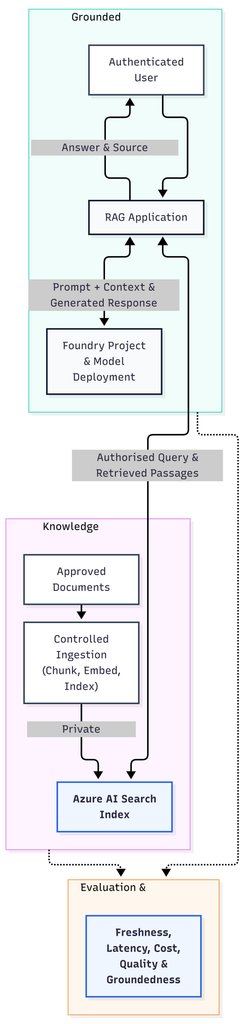
3. Production RAG: Bridging Grounded Knowledge Safely
For enterprise workloads, Retrieval-Augmented Generation (RAG) grounds generative models in trusted organizational knowledge.
A scalable RAG pattern cleanly separates background document lifecycle management from real-time user answering:
- Controlled Knowledge Ingestion: Approved enterprise documents are authorized at the source, parsed, chunked, and embedded through a private ingestion pipeline into an Azure AI Search index. Source updates and deletions synchronize automatically.
- Grounded Answering: When an authenticated user submits a prompt, the application issues an authorized query against the search index, retrieves relevant passages, and pairs them with the prompt inside the Foundry project workspace. The model deployment generates an answer with explicit source references.
- Continuous Evaluation: The entire pipeline is wired to an evaluation and monitoring plane that tracks response quality, groundedness (faithfulness to source data), freshness, latency, and cost.

4. The Operational Pipeline: From Onboarding to Continuous Improvement
Scaling AI across multiple teams requires structured lifecycle management. A repeatable delivery pipeline moves workloads systematically across three distinct phases:
- Onboarding: Workload owners submit a request detailing the business scope and data classification. The platform team leverages automated Infrastructure-as-Code (IaC) to provision an isolated, compliant project workspace.
- Delivery: Development teams build the agentic flow or application, validate outputs against behavioral evidence, pass risk-based approval gates, and promote the solution into release.
- Operations: In production, workloads are actively operated and monitored. Drift signals, performance bottlenecks, and user feedback loop back directly to the build stage for continuous iteration.
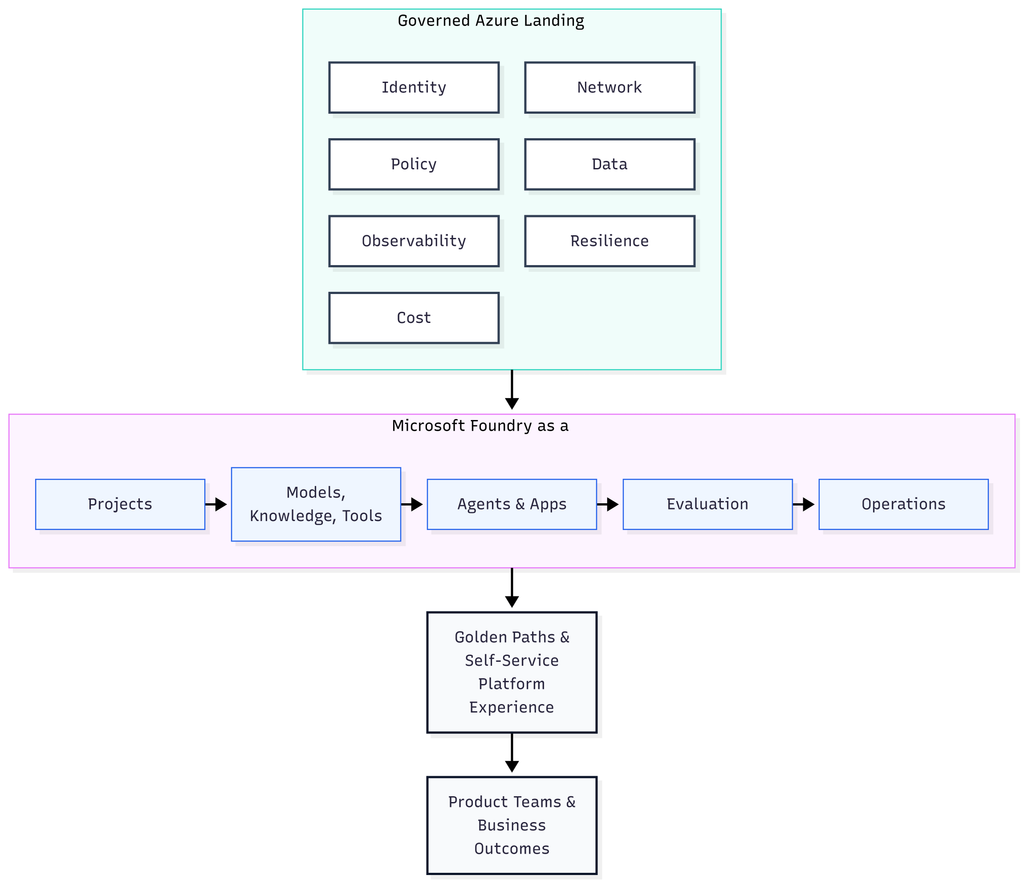
5. Enterprise AI Portfolio: The Foundation and Factory
True scale occurs when an enterprise treats AI enablement as an industrial factory rather than an artisanal workshop. This requires stacking four organizational layers:
- Governed Azure Landing Zone: The foundational platform plane providing core enterprise standards: identity, networking, policies, data access, observability, resilience, and cost controls.
- Microsoft Foundry as a Factory: The middle workbench where project workspaces assemble raw capabilities—models, proprietary knowledge, and tools—into testable agents and apps with standardized evaluation and operational tooling.
- Golden Paths & Self-Service Experience: Pre-architected deployment templates and guided workflows that allow product teams to deliver solutions without re-inventing baseline compliance, network routing, or security rules.
- Product Teams & Business Outcomes: The top tier where business units focus entirely on driving measurable value and customer impact, confident that the underlying platform enforces enterprise safety by default.
The Takeaway
Moving from proof-of-concept experiments to enterprise-grade AI demands architecture that treats machine work as an operational discipline. By combining a shared gateway, human-in-the-loop tool boundaries, governed RAG retrieval, and structured delivery pipelines, organizations create an environment where agents operate safely and deliver compounding value.