Building production-grade Generative AI for the enterprise requires moving far beyond simple vector search or basic RAG pipelines. When launching true enterprise applications, developers and data architects quickly run into a wall of complex requirements: reliable multi-source integration, safe model usage, query reasoning, answer synthesis, and strict governance.
Microsoft Foundry IQ serves as the enterprise-grade knowledge intelligence layer built directly inside the Azure AI Foundry platform to bridge this exact gap. It takes raw enterprise data and elevates it into a trustable, governable, and deeply intelligent knowledge base.
Architectural Hierarchy: Where Foundry IQ Fits
Azure provides multiple tiers of knowledge management. Understanding where low-level index mechanics stop and where Foundry IQ’s “brain” begins is crucial for designing your AI stack.
+-----------------------------------------------------------------------------+
| 3. FOUNDRY IQ KNOWLEDGE BASE                                                |
| Search KB + LLM Reasoning + Source Fusion + Governance + Synthesis + Eval    |
| (The Enterprise Intelligence Layer)                                         |
+-----------------------------------------------------------------------------+
                                      |
                                      v
+-----------------------------------------------------------------------------+
| 2. AZURE AI SEARCH KNOWLEDGE BASE                                           |
| Multi-Source Ingestion + Chunking + Embeddings + Agentic Retrieval          |
| (The Mid-Level RAG Engine)                                                  |
+-----------------------------------------------------------------------------+
                                      |
                                      v
+-----------------------------------------------------------------------------+
| 1. AZURE AI SEARCH INDEX                                                    |
| Raw Vector & Keyword Indexing                                               |
| (The Low-Level RAG Building Block)                                          |
+-----------------------------------------------------------------------------+
Azure AI Search KB vs. Foundry IQ KB
While Azure AI Search handles the underlying structural mechanics of vector storage and document chunking, Foundry IQ provides the cognitive and governance wrapper.
Azure AI Search Knowledge Base
- Core Focus: Fundamentally a retrieval and semantics layer.
- Capabilities: Supports Blob/SharePoint ingestion, hybrid keyword/vector search, and native embedding orchestration.
- Limitations: It acts as a high-performance search engine, but lacks native policy controls, multi-source fusion reasoning, human-ready answer synthesis, and evaluation tools.
Foundry IQ Knowledge Base
- Core Focus: An end-to-end knowledge intelligence layer.
- Capabilities: Uses Azure AI Search KB behind the scenes as its database engine, but wraps it with advanced LLM reasoning, governance, and evaluation suites.
- The Equation:$$\text{Foundry IQ} = \text{AI Search} + \text{LLM Reasoning} + \text{Multi-Source Orchestration} + \text{Governance} + \text{Synthesis} + \text{Evaluations}$$
Behind the Scenes: The 5-Stage Lifecycle of a Query
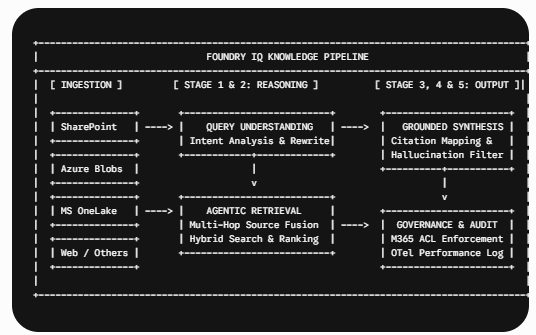
When an application or an AI agent submits a request to Foundry IQ, it triggers a sophisticated, five-stage execution pipeline:
1. Query Understanding
Before running any search, an inner LLM layer evaluates the raw user intent. It extracts key entities, identifies multi-part compound questions, and transparently rewrites the query to maximize semantic recall.
2. Retrieval Reasoning (Agentic Retrieval+)
Foundry IQ dynamically determines which knowledge sources are best suited for the task. It evaluates whether to run keyword, vector, hybrid, or multi-hop search, coordinates across multiple disjoint data silos (e.g., combining SharePoint data with OneLake records), and fuses the results.
3. Grounded Answer Synthesis
Once the relevant document chunks are mined, an LLM synthesizes a clean, fact-based response. This step actively sanitizes the output: ensuring explicit grounding, removing potential hallucinations, resolving conflicting data points, and appending verifiable citations.
4. Governance and ACL Trimming
Security is handled natively at the platform layer. Foundry IQ automatically respects M365 ACL inheritance and document-level permissions. Your application code never has to manually write or inject security trimming filters.
5. Continuous Evaluation and Telemetry
Every transaction logs crucial metrics for enterprise oversight, tracking explicit token consumption, retrieval precision, grounding accuracy scores, and potential hallucination indicators.
Feature Matrix Comparison
| Capability | Azure AI Search (Agentic Mode) | Foundry IQ |
| Ingestion Scope | Single indexes or targeted storage accounts. | Unified multi-source fusion (SharePoint, Blob, OneLake, Web). |
| Query Strategy | LLM-assisted search step optimization. | Advanced query decomposition, rewriting, and multi-hop routing. |
| Response Output | Raw semantic chunks or extractive sentences. | Factual, synthesized answers with native citation mapping. |
| Access Security | Manual application-side security filtering. | Automated inheritance of native M365 and SharePoint ACLs. |
| System Testing | Basic query log tracking. | Comprehensive evaluation suite (grounding, hallucination metrics). |
Core Functional Takeaways
- The Core Formula: Foundry IQ combines the raw retrieval of Azure AI Search with advanced LLM reasoning, multi-source orchestration, strict governance compliance, and precise output synthesis.
- Grounded Synthesis: The platform natively sanitizes raw documentation chunks into clear, fact-based answers while appending verifiable citations and filtering out hallucinations.
- Zero-Code Security: Out-of-the-box inheritance of native M365 and SharePoint ACLs means security trimming happens at the platform layer without manual application coding.