In enterprise IT, technology mandates often travel faster than technical rationale. Few mandates are as common—or as costly—as the decree that “everything must be containerized.”
When an application is already modern, modular, running on up-to-date runtimes, and operating cleanly on Azure Virtual Machines, forcing a migration to containers (such as Azure Kubernetes Service or Azure Container Apps) rarely delivers the operational benefits promised on whiteboards.
When combined with a mandate to extract APIs into an out-of-process cross-subscription “sidecar” pattern, the project ceases to be modernization—it becomes an exercise in accidental complexity, compounding operational costs, and introducing architectural risk.
This analysis provides a management report, architectural comparison, and technical assessment evaluated against the Pivotal Cloud Foundry (PCF) / Heroku 12-Factor App methodology to demonstrate why this initiative should not proceed.
Executive Summary & Cost-Complexity Scorecard
Containerization is a deployment packaging mechanism, not an indicator of software quality. If an application already adheres to modern engineering standards, containerizing it yields diminishing returns while introducing substantial platform overhead.
Here is the trade-off scorecard structured into a clear, simple table based on your post:
| Metric / Dimension | Current State (Modernized VMs) | Proposed (Containers + Cross-Sub Sidecar) |
| Estimated Migration Time | 0 Weeks (Baseline operational) | 32–48 Weeks (Analysis, packaging, PoC) |
| Implementation Cost | £0 Capital Outlay | £450k – £750k (Eng effort + tooling) |
| Running Infrastructure | Baseline Compute + Disk | +25–40% (Cluster overhead, VNet/PE) |
| Latency Overhead | Local/Subnet Wire Speed (<1ms) | Network transit + TLS proxy (5–25ms) |
| Blast Radius / Failure | Isolated to VM / App Domain | Cascading across subscriptions/mesh |
| Operational Complexity | Low (Standard OS / Azure DevOps) | Very High (K8s Day-2, CNI, Mesh, IAM) |
Architectural Comparison: Current State vs. Proposed Mandate
1. Current State: Clean VM Topology
The existing system operates with up-to-date components, consolidated networking, and co-located APIs operating within a single, secure application boundary.
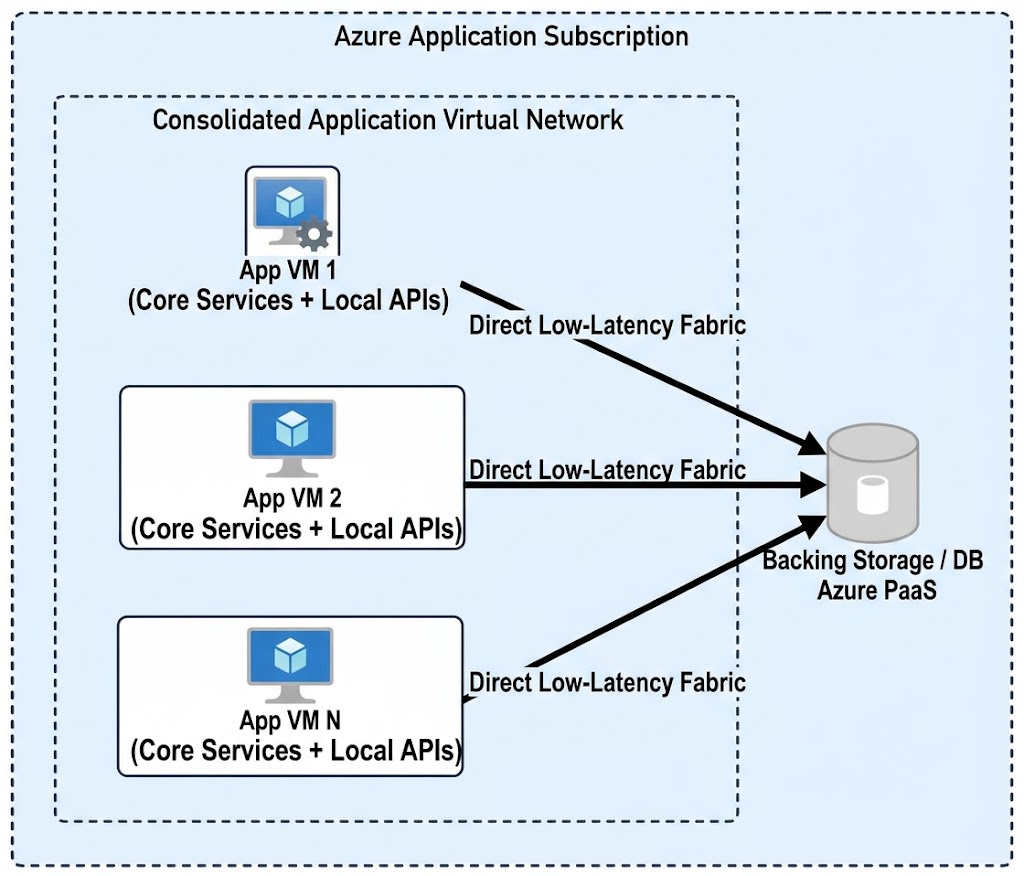
- Network Path: Single VNet hop. Communication between services and internal APIs is in-memory or intra-subnet.
- Security Perimeter: Single RBAC and policy perimeter managed inside the application team’s subscription.
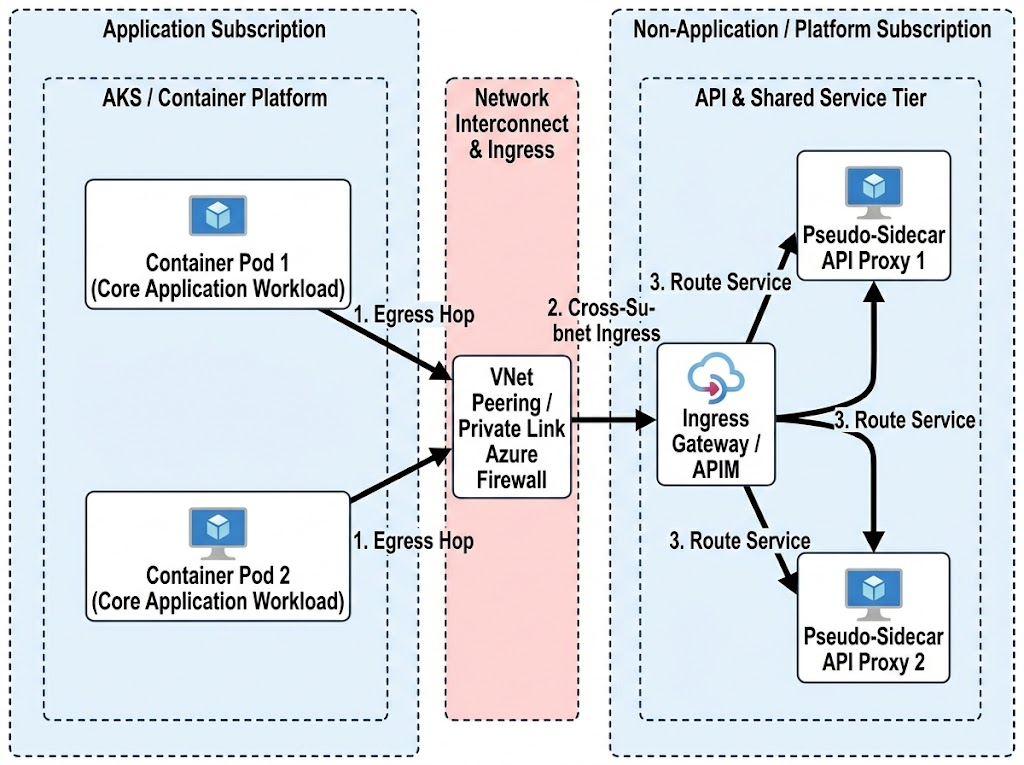
2. Proposed State: Containers with Cross-Subscription “Sidecar” Routing
The proposed mandate places APIs into a separate non-application subscription and attempts to use a “sidecar” pattern over network boundaries.
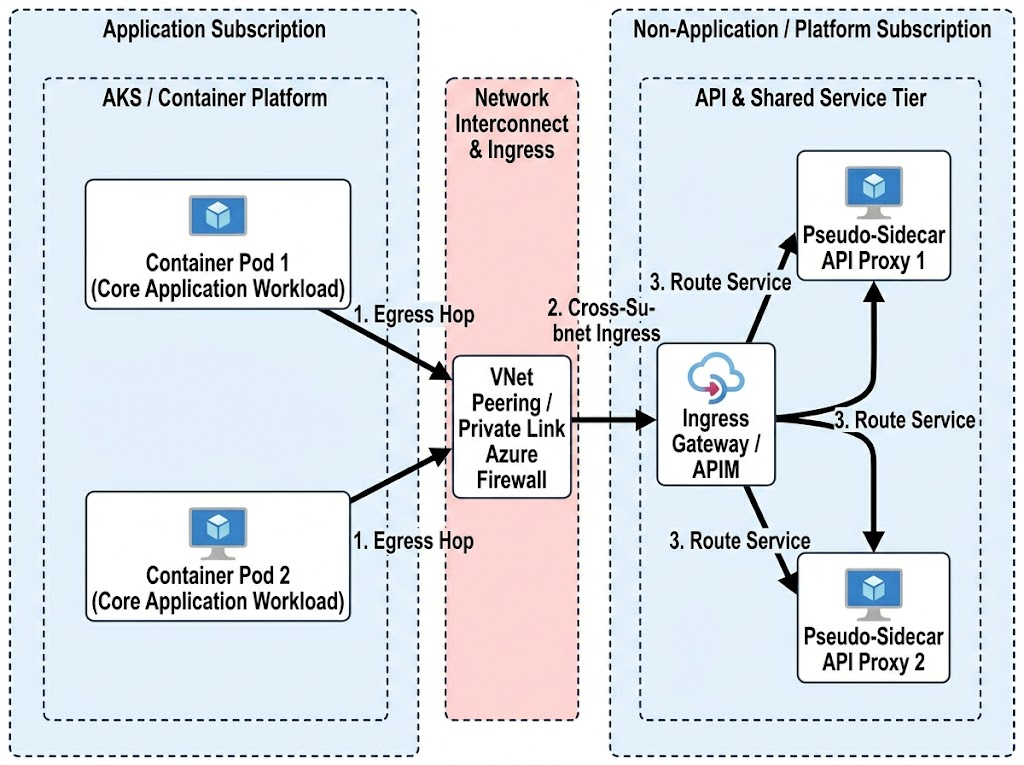
The Cross-Subscription “Sidecar” Fallacy
In distributed systems design, a Sidecar Pattern requires the auxiliary process to be co-located on the same lifecycle boundary and network namespace as the main application (i.e., within the exact same Kubernetes Pod, localhost interface, or VM instance).
Placing an API or proxy into another Azure subscription and calling it a “sidecar”:
- Violates Distributed Systems Principles: A cross-network call to another subscription is not a sidecar—it is an out-of-process, high-latency remote microservice dependency.
- Introduces Cross-Subscription Network Inefficiencies: Every request must traverse VNet Peering, Private Endpoints, or Azure Firewalls, turning what was a sub-millisecond local inter-process communication (IPC) into a multi-hop, TLS-negotiated network hop subject to latency spikes (5ms–30ms per round-trip).
- Fragmented Security Boundaries: Cross-subscription routing requires distributed Entra ID application registrations, cross-tenant/cross-subscription RBAC, separate Key Vaults, and split network security groups (NSGs), exponentially increasing the surface area for audit and permission failures.
- Two-Phase Deployment Deadlocks: Updating an API requires coordinating deployments across two separate subscriptions with two distinct release pipelines and teams, eliminating any agility gained from containerization.
12-Factor App Analysis: VMs vs. Containers
The 12-Factor App methodology provides a benchmark for evaluating whether an architecture is cloud-native and resilient. Containers are merely one vehicle to deliver these factors; a well-managed VM estate can implement them just as effectively.
Key Insights from the 12-Factor Review
- Factors 1–5 (Hygiene & Config): The application already separates code, configuration, and dependencies cleanly. Moving to container images adds packaging overhead without improving isolation.
- Factor 6 & 8 (Statelessness & Concurrency): Scaling horizontally across Azure Virtual Machine Scale Sets (VMSS) provides identical elasticity to Kubernetes pods for large workloads, without the control-plane overhead.
- Factor 7 & 9 (Port Binding & Disposability): The application already binds cleanly and shuts down gracefully. Forcing a cross-subscription API proxy introduces network coupling that explicitly degrades Factor 9 (Disposability).
Conclusion: The application already satisfies 12-Factor principles. Containerization provides zero architectural uplift to application health.
Detailed Management Breakdown: Time, Cost, and Complexity
1. Timeline & Resource Allocation (32–48 Weeks)
Migrating an enterprise multi-tier estate to containers and re-platforming APIs across subscription boundaries is a major re-platforming project.
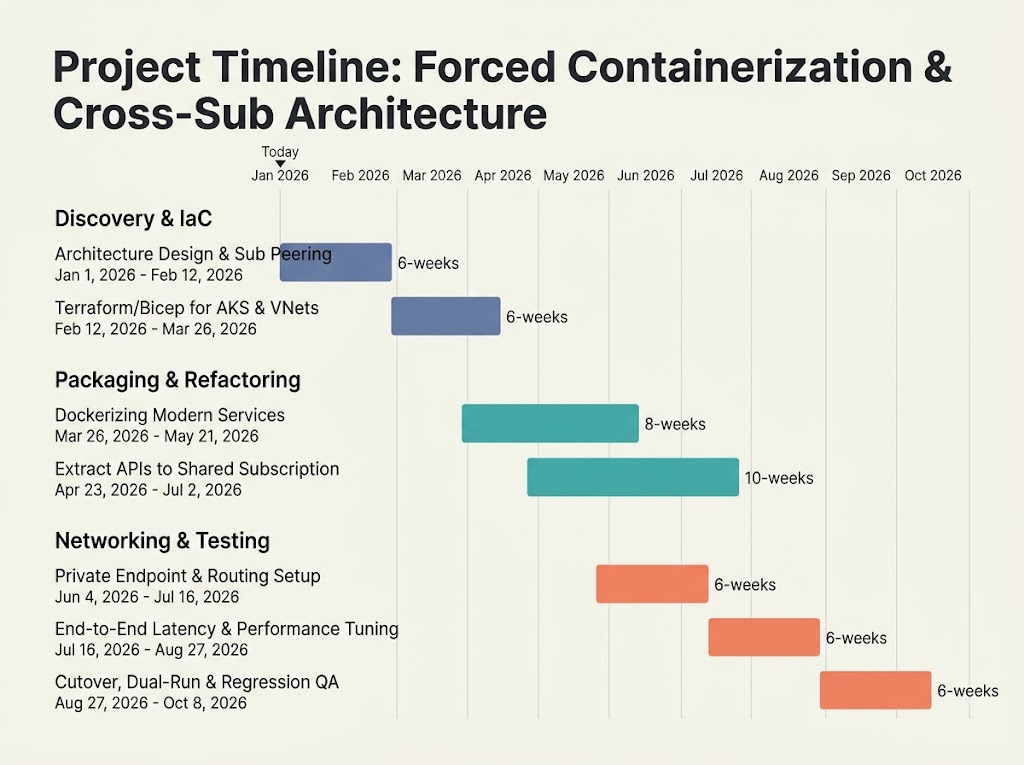
- Total Duration: 9–12 months of specialized engineering effort.
- Opportunity Cost: Feature development for the core business is frozen while developers troubleshoot networking, CNI IP exhaustion, and container deployment pipelines.
2. Financial Analysis: The Hidden Cloud & Consulting Tax
Organizations often believe containers reduce cloud spend. In enterprise architectures, the opposite is typically observed:
- System Overhead: Kubernetes control planes, system node pools, ingress controllers, monitoring sidecars, and cluster log shippers consume 15–25% of baseline VM CPU and RAM before application code executes.
- Inter-VNet Data Transfer Costs: Shuffling high-volume API payloads across subscription and VNet boundaries incurs persistent data egress and Private Link processing fees.
- Tooling & Licensing Costs: Dedicated enterprise container registries (ACR Premium), container security scanning tools (Defender for Containers, Aqua, or Snyk), and API Management instances across subscriptions inflate operational expenditure.
- Engineering Headcount: Demands specialized Kubernetes administrators and platform engineers whose salaries exceed traditional infrastructure and application support personnel.
3. Day-2 Operational Complexity
Adopting containers is not a one-time build task; it is an ongoing operational commitment:
- Kubernetes Upgrade Churn: AKS versions have a strict deprecation cadence. Teams must plan and execute cluster upgrades every 3–6 months to remain supported, continuously validating API deprecations.
- Triage Inefficiencies: Debugging an incident requires cross-referencing distributed traces across two subscriptions, multiple Virtual Networks, Kubernetes ingress controllers, and API proxies—multiplying Mean Time to Recovery (MTTR).
Recommendations for the Application Owner
- Challenge the Mandate with Architecture Evidence: Present this 12-Factor evaluation to demonstrate that the application already meets all cloud-native objectives without container encapsulation.
- Reject the Cross-Subscription “Pseudo-Sidecar”: If enterprise APIs must be centralized, advocate for standard API Gateway routing (such as Azure API Management) using native endpoints, rather than masquerading cross-subscription dependencies as a sidecar.
- Propose Pragmatic Modernization: If the business objective is automated deployments and higher density, achieve it via Azure Virtual Machine Scale Sets (VMSS) using automated image builds or transition to managed PaaS services (e.g., Azure App Service) rather than full Kubernetes orchestration.
AI Acceleration & Reality Check: Can Generative Tooling Bypass the Migration Tax?
With the proliferation of AI coding assistants (such as GitHub Copilot, Cursor, and automated IaC generators), engineering teams often assume that tedious refactoring, Dockerization, and cross-subscription pipeline creation can be heavily automated. While AI drastically compresses boilerplate creation, it cannot eliminate the fundamental architectural and governance constraints of enterprise cloud platforms.
The Impact: Where AI Delivers vs. Where It Hits a Wall
| Project Dimension | Human-Only Baseline Effort | AI-Assisted Timeline | What AI Accelerates | The Hard Enterprise Ceiling |
| 1. Architecture & Sub Peering | 6 Weeks | 4 Weeks | Drafting Architecture Decision Records (ADRs), subnet sizing models, and baseline security templates. | Cross-team security reviews, CAB sign-offs, and tenant-level peering permissions. |
| 2. IaC Generation (Terraform/Bicep) | 6 Weeks | 3 Weeks | Scaffolding modular AKS definitions, VNet peering configs, and Private Endpoint links. | Azure subscription quota limits, route table debugging, and state file locking. |
| 3. Container Packaging & Dockerfiles | 8 Weeks | 3–4 Weeks | Writing multi-stage Dockerfiles, .dockerignore filters, and entrypoint boot scripts. | Validating legacy runtime quirks, non-root user permissions, and native OS dependencies. |
| 4. API Extraction to Shared Sub | 10 Weeks | 5–6 Weeks | Generating OpenAPI specifications, mocking interface contracts, and scaffolding CI/CD YAML. | Entra ID multi-tenant app registrations, cross-subscription RBAC, and token exchange auth complexity. |
| 5. Private Link & Network Routing | 6 Weeks | 4 Weeks | Generating Azure Firewall network rules and Private DNS Zone configurations. | NSG troubleshooting, asymmetric routing diagnostics, and transit VNet packet inspection. |
| 6. Latency & Performance Tuning | 6 Weeks | 4 Weeks | Analyzing load-test scripts (k6/JMeter) and parsing APM telemetry for hotspots. | Physical network hop latency (5–25ms wire speed), TLS handshake overhead, and sidecar proxy constraints. |
| 7. Dual-Run, QA & Cutover | 6 Weeks | 4–5 Weeks | Generating synthetic regression test suites and automated log reconciliation scripts. | Production data integrity verification, rollback drills, and cross-team cutover coordination. |
| Total Duration Range | 32–48 Weeks | 20–30 Weeks | — | — |
Key Architectural Takeaways for Leadership
- A 35–40% Timeline Compression: AI tooling successfully shortens the overall delivery window from 32–48 weeks down to 20–30 weeks, primarily by removing the friction of manual script writing and configuration scaffolding.
- The Non-Negotiable Governance Ceiling: AI cannot bypass organizational friction. Entra ID permissions, enterprise InfoSec compliance, cross-subscription network routing, and change advisory board (CAB) approvals remain entirely human-driven bottlenecks.
- The Physics of Network Latency: No amount of code generation can mitigate the fundamental network penalty introduced by a forced cross-subscription “sidecar” pattern—every remote proxy hop still incurs the same TLS negotiation and transit latency overhead.