A striking prediction by industry analysts at Gartner reveals that more than 40 percent of agentic AI projects will be canceled by the end of 2027. When these systems fail in production, it is rarely due to a weak AI model. Instead, the true culprit is a lack of operational context.
Without a centralized context layer, developers are forced to hand-stitch fragmented data sources, permission models, and orchestration logic for every single agent they build. This results in brittle systems that hallucinate, miss policy boundaries, and fail in production.
To build reliable agents that act like seasoned employees rather than lost new hires, organizations must establish a unified, reuseable context layer. This is precisely what Microsoft IQ provides.
One Context Layer, Four Sources of Truth
Microsoft IQ acts as a unified intelligence layer for enterprise AI. Rather than a disconnected suite of products, it combines four distinct context engines into a single, permission-aware surface that answers specific enterprise questions:
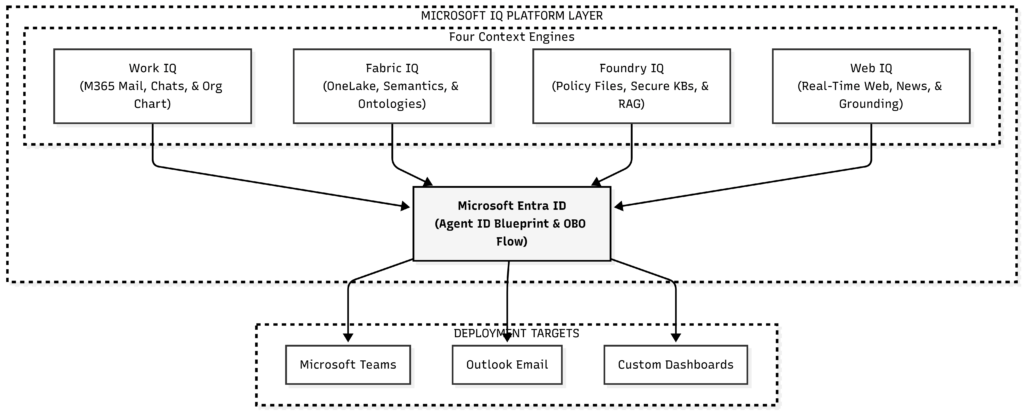
- Work IQ (“How your employees work”): Supplies contextual insights regarding people, collaboration dynamics, and corporate workflows directly from Microsoft 365. It functions over secure protocols (A2A, MCP, REST) providing safe workspace states, messaging tools, and direct data-in-place context without external indexing.
- Fabric IQ (“How your business operates”): Elevates raw rows and columns into actual business meaning. It surfaces data via OneLake (the centralized, zero-ETL data tier), unifies reporting metrics with Semantic Models, and maps business logic using Ontologies where data is expressed via concepts (“Customer”, “Package”) and verbs rather than complex foreign database keys.
- Foundry IQ (“How your agents unlock knowledge”): Serves as a reusable enterprise knowledge repository featuring an automated, agentic retrieval engine. Instead of a single-shot RAG search, it runs multi-hop iterative query planning, re-ranking, and produces safe, citation-backed answers.
- Web IQ (“How you connect to web intelligence”): Engineered explicitly for ultra-low latency agent workflows (sub-165ms p95 latency), exposing structured, citation-ready content from the open web, news, and live media with zero data retention.
Architectural Breakdown: Production-Grade Identity and Hosting
Moving an agent out of the prototyping sandbox requires rigid enterprise guardrails. Microsoft IQ enforces security, execution, and monitoring at the platform level:
1. Identity via Microsoft Entra Agent ID
Every autonomous agent is provisioned with its own Microsoft Entra Agent ID—a special service principal configured from a reusable blueprint template. This provides the agent with its own scoped cryptographic identity and mailbox.
Instead of piggybacking broadly on a master administrator account, the agent acquires explicit, isolated tokens using an On-Behalf-Of (OBO) flow via the Microsoft Authentication Library (MSAL). This ensures the agent can only read or write to data it has explicit permission to touch, keeping audit trails linked to a responsible human sponsor.
2. Hosting via the Microsoft 365 Agents SDK
Production-ready agents are stood up using the Microsoft 365 Agents SDK, running on a high-efficiency CloudAdapter and aiohttp web server host. This application scaffolding maps directly to built-in open-source observability frameworks via OpenTelemetry (OTel), routing comprehensive step-by-step logs into Azure Application Insights.
The result is a highly governable, trackable, and compliant agent that interacts natively across Outlook, Microsoft Teams, and custom enterprise dashboard endpoints.
Designing on Purpose: Structural Quick Comparison
| Strategic Dimension | Traditional Custom Pipeline | Microsoft IQ Platform Layer |
| Data Architecture | Duplicate data stores, high-maintenance custom ETL pipelines. | Zero-copy access via OneLake Shortcuts and semantic reuse. |
| Security Design | Complex application-side security patching and custom ACL matching. | Native inheritance of Entra IDs, M365 permissions, and Purview labels. |
| Retrieval Quality | Single-shot keyword or simple vector RAG search mechanisms. | Agentic Retrieval with iterative query planning and multi-hop fusion. |
| Deployment Flow | Brittle scripts tied to static API tokens or master web apps. | Scoped Agent IDs with clear human ownership and org chart identities. |