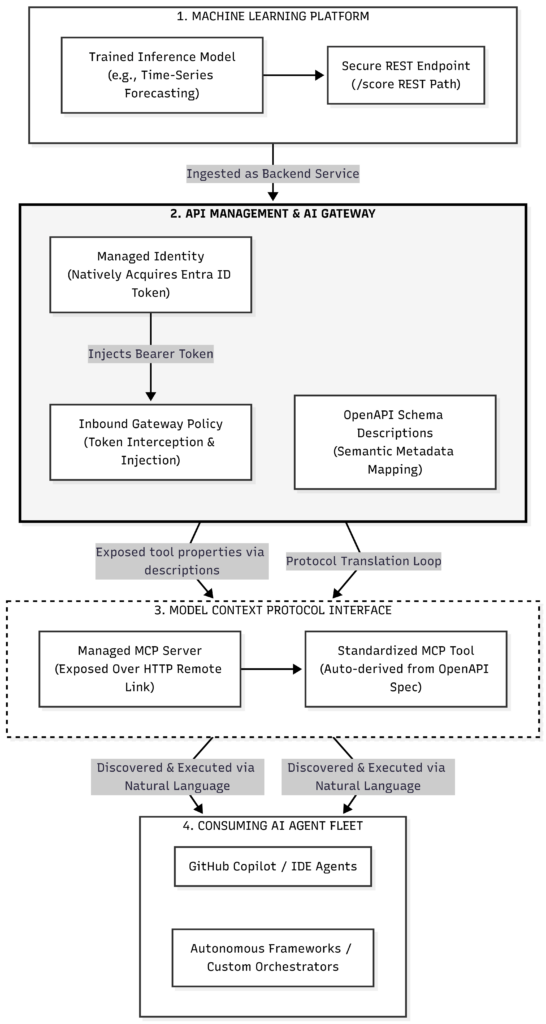
In enterprise AI, a major engineering challenge is bridging the gap between existing backend systems and the fast-growing ecosystem of autonomous AI agents. A common pitfall is attempting to rebuild or custom-code dedicated connector logic for every internal API an agent needs to access.
A more elegant, enterprise-grade approach relies on a clever architectural bridge: deploying a trained model to an machine learning platform, routing it through an API management layer with built-in gateway capabilities, and automatically exposing it as a standardized Model Context Protocol (MCP) service.
The Conceptual Architecture
This pattern allows organizations to take protected, internal inference endpoints and expose them to AI agents in a highly structured, governed, and reusable format—all without modifying the underlying business logic.
Step 1: Secure the Inference Endpoint
The lifecycle begins with a specialized model (such as a time-series forecasting model) deployed to a managed cloud runtime. Rather than securing this endpoint with fragile, hard-coded static API keys, the endpoint is protected using enterprise token-based authentication (e.g., Microsoft Entra ID).
Step 2: Ingest and Govern via the API Gateway
Next, the raw REST endpoint is registered behind an enterprise API Management (APIM) gateway instance. The gateway layer assumes two critical structural roles:
- Token Delegation & Managed Identity: Instead of forcing downstream clients or AI agents to manage custom authentication headers, the gateway uses its own Managed Identity to dynamically acquire short-lived access tokens from the identity provider and inject them directly into the backend
Authorization: Bearer <token>header. - OpenAPI as the Semantic Source: The API is defined using a standard OpenAPI/Swagger specification. In the agentic era, the
descriptionfields within this schema are no longer just documentation—they represent the actual semantic context the agent reads to determine when and how to call the tool.
XML
<!-- Example Gateway Inbound Policy Configuration -->
<policies>
  <inbound>
    <base />
    <!-- 1. Route to the secure cloud machine learning backend -->
    <set-backend-service backend-id="ml-prediction-api-backend" />

    <!-- 2. Dynamically fetch a secure token using the gateway's managed identity -->
    <authentication-managed-identity resource="https://ml.azure.com" output-token-variable-name="ml-access-token" ignore-error="false" />

    <!-- 3. Inject the token safely into the authorization header -->
    <set-header name="Authorization" exists-action="override">
      <value>@("Bearer " + (string)context.Variables["ml-access-token"])</value>
    </set-header>
  </inbound>
</policies>
Step 3: Automatically Expose the MCP Server
Once governed by the gateway, the REST API is exposed as an MCP Server via an HTTP protocol hook. Under the hood, the gateway automatically transforms the underlying REST path schemas into formalized MCP Tools.
Because the gateway handles token exchange natively, the exposed MCP tool remains completely decoupled from the security plumbing, drastically reducing prompt overhead and structural complexity for the calling agent.
Step 4: Native Agent Execution
With the MCP server live, any compatible agentic framework or CLI developer environment can add the server remotely over HTTP. When a user prompts the agent with a natural language goal, the LLM parses the server’s tool registry, matches the exact utility based on the OpenAPI metadata descriptions, and safely executes the underlying machine learning calculation.
Strategic Advantages for Enterprise AI
- Robust Keyless Security: By pairing managed cloud identities with token-based gateway authorization, you eliminate the risk of hard-coded API key leakage across agent codebases.
- Semantic Context Reuse: You write your OpenAPI document descriptions clearly once, and every downstream MCP-compatible agent instantly gains the context needed to choose and execute the tool correctly.
- Maximum Legacy ROI: Organizations do not need to rewrite legacy internal REST services to support the new agent economy; the gateway serves as an immediate, non-disruptive protocol translator.
The Bottom Line: Centralizing authentication, security boundaries, and logging at the API Gateway layer provides the necessary infrastructure to confidently scale, track, and expose secure enterprise capabilities to an autonomous fleet of AI agents.